← Back to Collections

 Get the app
Pablo Picasso
Shapes and abstraction
A curated selection of Picasso's iconic works spanning his many periods, perfect as rotating art on your screen.
In this collection
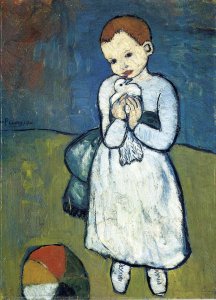
- Child with dove 1901. Painted at the dawn of his Blue Period, this tender portrait captures a quiet innocence that contrasts with the melancholy soon to define his work.
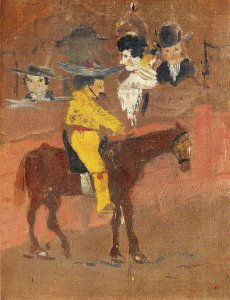
- The picador c. 1890. One of Picasso’s earliest known paintings, it reveals the young artist’s fascination with bullfighting, a theme that would echo throughout his career.
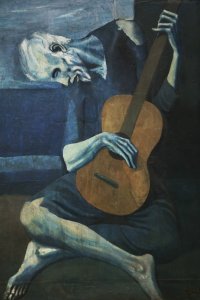
- The Old Guitarist Painted in Barcelona in late 1903 and early 1904, at the height of the Blue Period: a gaunt, blind street musician in shades of blue. Art Institute of Chicago.
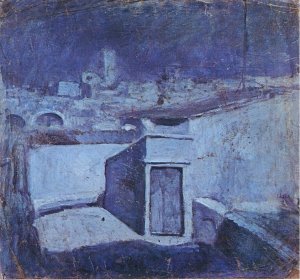
- The roofs of Barcelona in the moonlight 1903, Blue Period. A night view over the rooftops of Barcelona, where Picasso was living at the time, painted almost entirely in blues.
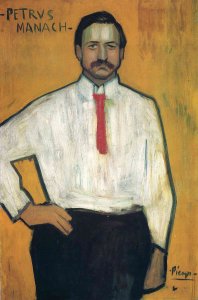
- Portrait of Pere Mañach 1901. Pere Mañach was Picasso's first dealer in Paris and helped arrange his 1901 exhibition at Ambroise Vollard's gallery.
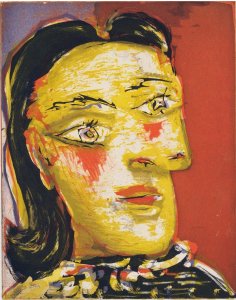
- Head of a Woman (No. 4) 1939. One of a series of heads of Dora Maar, the photographer and painter who was Picasso's companion in the late 1930s.
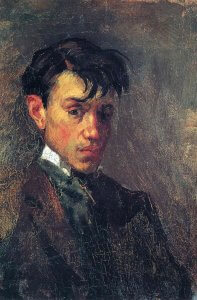
- Self-Portrait 1896. Painted as a teenage art student in Barcelona, already with the skill of a trained academic painter. Museu Picasso, Barcelona.
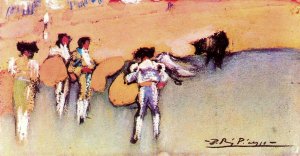
- Bullfighters and Bull Waiting for the Next Move 1900. Bullfighting is one of the oldest subjects in Picasso's work, from his childhood drawings to his last paintings.
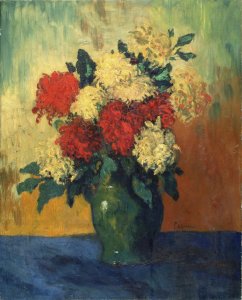
- Chrysanthemums 1901. A still life of chrysanthemums in bright colour, painted in the year his Blue Period began. Philadelphia Museum of Art.
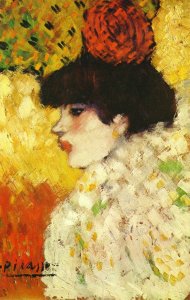
- Profile of a Young Girl 1901. Also known as Girl with a Red Flower in Her Hair, painted in the year his Blue Period began.
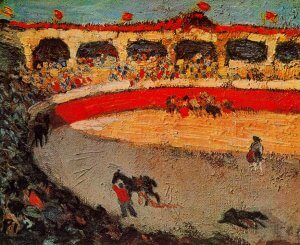
- The Corrida 1901. A crowded bullfight in vivid colour, from the year Picasso first exhibited in Paris.
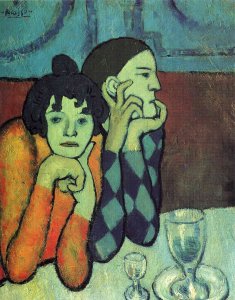
- Two Acrobats (Harlequin and His Companion) 1901. Two weary performers at a café table. Harlequins and circus figures became one of Picasso's lasting themes.
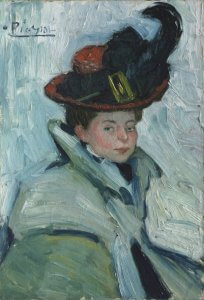
- Woman with Hat 1901. Oil on canvas (73 × 50 cm), from the year his Blue Period began.
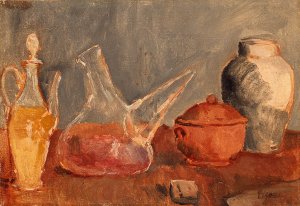
- Still Life with Vases 1906, the year Picasso moved from the warm tones of his Rose Period toward the simplified forms that led to Cubism.
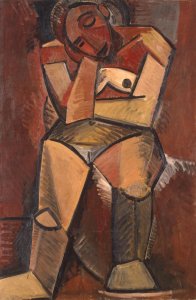
- Seated Woman 1908. An early Cubist figure built from heavy, angular volumes, painted the year after Les Demoiselles d'Avignon (150 × 99 cm). Hermitage Museum, St. Petersburg.
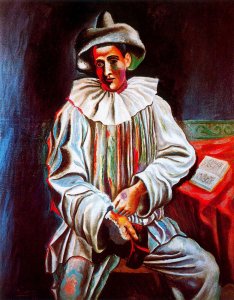
- Pierrot with a Mask 1918. The commedia dell'arte figure of Pierrot appears often in Picasso's work in the years he designed for the Ballets Russes.
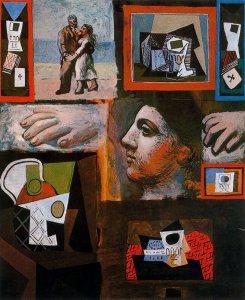
- Studio 1920. A studio scene from the years after the First World War, when Picasso moved between Cubism and a return to classical drawing.
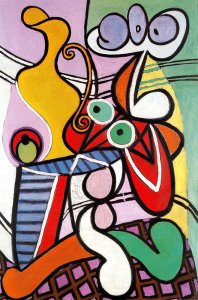
- Great Still Life on Pedestal 1931. A large still life (195 × 130 cm) on a pedestal table, painted in curving lines and bright colour. Musée Picasso, Paris.
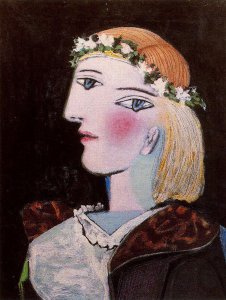
- Portrait of Marie-Thérèse Walter with Garland 1937. Marie-Thérèse Walter was Picasso's companion from the late 1920s and the mother of his daughter Maya.
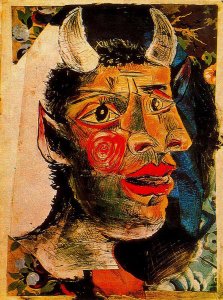
- Head 1938. Oil on canvas (65 × 54 cm), from the late 1930s, when Picasso's heads and portraits became sharply distorted.
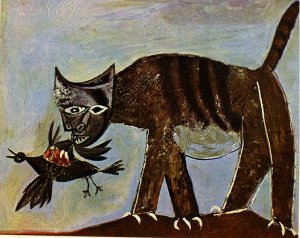
- Cat Catching a Bird 1939. A cat seizing a bird, painted in the year the Second World War began and often read as an image of violence (81 × 100 cm). Musée Picasso, Paris.
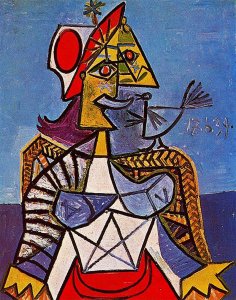
- Seated Woman 1939. Oil on canvas (92 × 73 cm), one of the many seated women Picasso painted in the late 1930s.
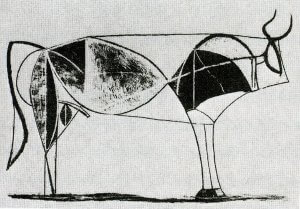
- Bull (Plate VII) 1945. Plate VII of The Bull, a series of lithographs made over the winter of 1945 to 1946 in which Picasso reduced a bull, step by step, to a few lines. Staatsgalerie Stuttgart.
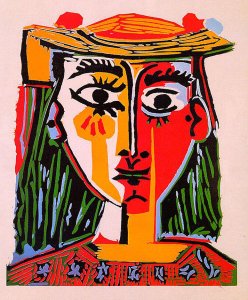
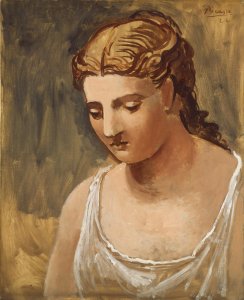
- Woman with Hat 1962. A late portrait (63 × 52 cm), from the years Picasso lived and worked in the south of France.
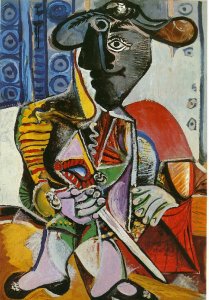
- Matador 1970. One of the large, quickly painted figures of his last years (195 × 130 cm), returning to the bullfighting theme he had painted since childhood.
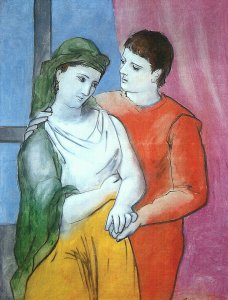
- Lovers 1923. A couple drawn with simple outlines and flat colour, from Picasso's classical period of the early 1920s (130 × 97 cm). National Gallery of Art, Washington.
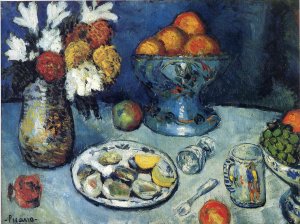
- Still life (The dessert) 1901. A table laid with dessert (59 × 78 cm), from the year his Blue Period began.
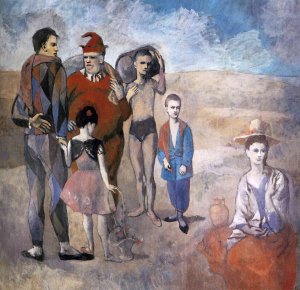
- Family of acrobats (Jugglers) 1905. Better known as Family of Saltimbanques, the largest painting of his Rose Period: travelling circus performers in an empty landscape (212 × 229 cm). National Gallery of Art, Washington.
- Classical Head 1922. A calm, sculptural head from Picasso's classical period, which followed his 1917 trip to Italy. National Gallery of Art, Washington.
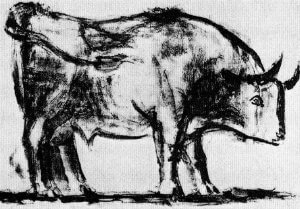
- Bull (Plate I) 1945. The first plate of The Bull: a solid, fully modelled bull, before Picasso reduces it to a few lines in the later plates. Museum of Modern Art, New York.
Show this collection on your photo frame
In Digital Photo Frame App, open Add Source, scroll to Curated Collections under Discover and choose Add to Library. The collection then plays like any album, on iPad, iPhone, Mac and Apple TV.
Get the app