The Second Life of the iPad: A Study of Older Apple Tablets and Device Reuse in 2026
How people use older Apple tablets as photo frames, and the potential to avoid buying an additional display device
Manuel Escrig · Observational first-party research · Prepared 26 October 2026 · Not peer reviewed
Study period: 1 October 2025 to 30 September 2026.
Author: Manuel Escrig, independent iOS developer.
Publisher: Digital Photo Frame App.
Study population: iPad-model identifiers observed on Start Slideshow events in the Digital Photo Frame App Mixpanel project.
Main finding: Across 10,318 model-specific counts of slideshow-active installation identifiers, 4,821 (46.7%) were associated with iPad model families introduced before 2020. Those older families generated 36,404 (41.9%) of 86,868 recorded slideshow-start events. These statistics describe one application's observed usage, not all iPads and not the age of the physical devices.
An iPad already sitting unused at home can become a digital photo frame through software rather than another hardware purchase. If that reuse replaces a planned purchase of a new frame, it can avoid demand for an additional electronic product and delay the existing tablet entering the waste stream. The study documents the older iPad models in active use; it does not measure how many purchases or emissions were avoided.
Abstract
This descriptive study examines the model-generation age of iPads that initiated slideshows in Digital Photo Frame App over 12 complete months. We queried the application's Mixpanel analytics, restricting observations to events with hardware identifiers beginning iPad. Distinct Mixpanel $device_id values were counted within each model identifier, and device strings were assigned the introduction year of their corresponding model family. The app recorded 10,258 distinct device identifiers with at least one slideshow-start event. Because an identifier could appear with more than one model category, the model-specific counts totalled 10,318, rather than 10,258. Of the latter, 46.7% related to model families introduced in or before 2019 and 25.1% to families introduced in or before 2016. These older families were also responsible for 41.9% of 86,868 slideshow-start events. The results document observable slideshow activity on older model generations, but do not establish original purchase dates, continuous years of ownership, hours of playback, whether hardware was repurposed, or e-waste avoided. The practical significance is a conditional substitution pathway: where an owner uses an existing iPad instead of buying a dedicated photo frame, software-led reuse may defer disposal of the tablet and avoid acquisition of an additional electronic product. This study did not measure purchase substitution, device energy consumption, avoided manufacturing or net environmental benefits.
1. Background and research question
Long-lived consumer devices can remain useful in narrower roles after their original owner no longer uses them as a general-purpose computer. Displaying family photographs is one such possible use of an older iPad. The potential social relevance is illustrated by the Global E-waste Monitor 2024, which estimated that 62 million tonnes of electronic waste were generated worldwide in 2022 and 22.3% was documented as formally collected and recycled [1]. This report does not attempt to measure environmental savings.
The practical alternative considered here is not buying a new iPad. It is using an iPad someone already owns in place of purchasing a separate digital photo frame. Digital Photo Frame App can provide slideshow functionality on existing iPad hardware without requiring that additional display to be manufactured. The European Union waste hierarchy explicitly identifies product reuse and lifespan extension as forms of waste prevention, ahead of recycling [5]. This makes continued, useful operation of existing electronics relevant to the e-waste discussion, even though no avoided-waste quantity can be inferred from app usage alone.
The research question was: What is the distribution of original model introduction years among iPad installations that recorded slideshow starts in Digital Photo Frame App during a complete 12-month observation period? A secondary question was whether older model generations contributed materially to recorded slideshow-start activity.
2. Methods
Data provenance and author relationship
This analysis uses aggregate event data collected by Digital Photo Frame App, a commercially distributed photo-slideshow application developed by the author. The app is identified here as the source of the underlying observations; this reference is not an endorsement or an assessment of the app's effectiveness. The data were retrieved from the publisher's Mixpanel project and analysed in aggregate. No personal photographs or raw pseudonymous device identifiers are included in this publication.
Design. A retrospective, descriptive analysis of first-party product analytics; not a representative household survey and not a longitudinal device-life study.
Observation period. 1 October 2025 through 30 September 2026, inclusive. A separate September 2026 check was used to confirm that older-model activity was also present near the end of the study period.
Eligibility. Events named exactly Start Slideshow, filtered to event property $model containing iPad. This excludes event records identified as iPhones, Macs or Apple TV devices. No further independent audit of internal/test traffic or event completeness was available at the time of extraction.
Primary counting unit. For each $model, Mixpanel's distinct count of $device_id values that triggered at least one qualifying event. $device_id is an SDK-generated identifier, not an immutable physical serial number; reinstalling or resetting identity can generate additional identifiers. The globally deduplicated distinct-ID count was 10,258; the sum of all model-specific distinct-ID counts was 10,318. The difference of 60 (0.6% of model-specific counts) represents cross-model overlap when aggregating by model and means model-bucket sums should not be presented as distinct physical iPads. All release-year shares below explicitly use the 10,318 model-specific-count denominator, not 10,258.
Model year assignment. Hardware strings such as iPad4,1 were mapped to the iPad model family and its first introduction year using the hardware identifier table at iOS Ref [2], cross-checked against Apple's model identification support document [3]. Later regional/cellular variants may have had later release dates; the family year is used consistently. Unknown mappings would have been omitted; all 90 observed model identifier categories were mapped.
Activity measure. Total recorded Start Slideshow events, by model and aggregated into release-year cohorts. One start event does not prove successful or continuous playback or any minimum session length.
Interpretation. All results are descriptive of instrumented app events; no statistical significance testing or population-wide confidence interval is presented because the study population is self-selected and the larger sampling frame is unknown.
3. Results
3.1. Nearly half of model-specific counts were on iPads from before 2020
The study identified 10,258 globally distinct Mixpanel device IDs that started at least one slideshow in the year. The model-specific breakdown comprised 10,318 counts across 90 hardware identifiers.
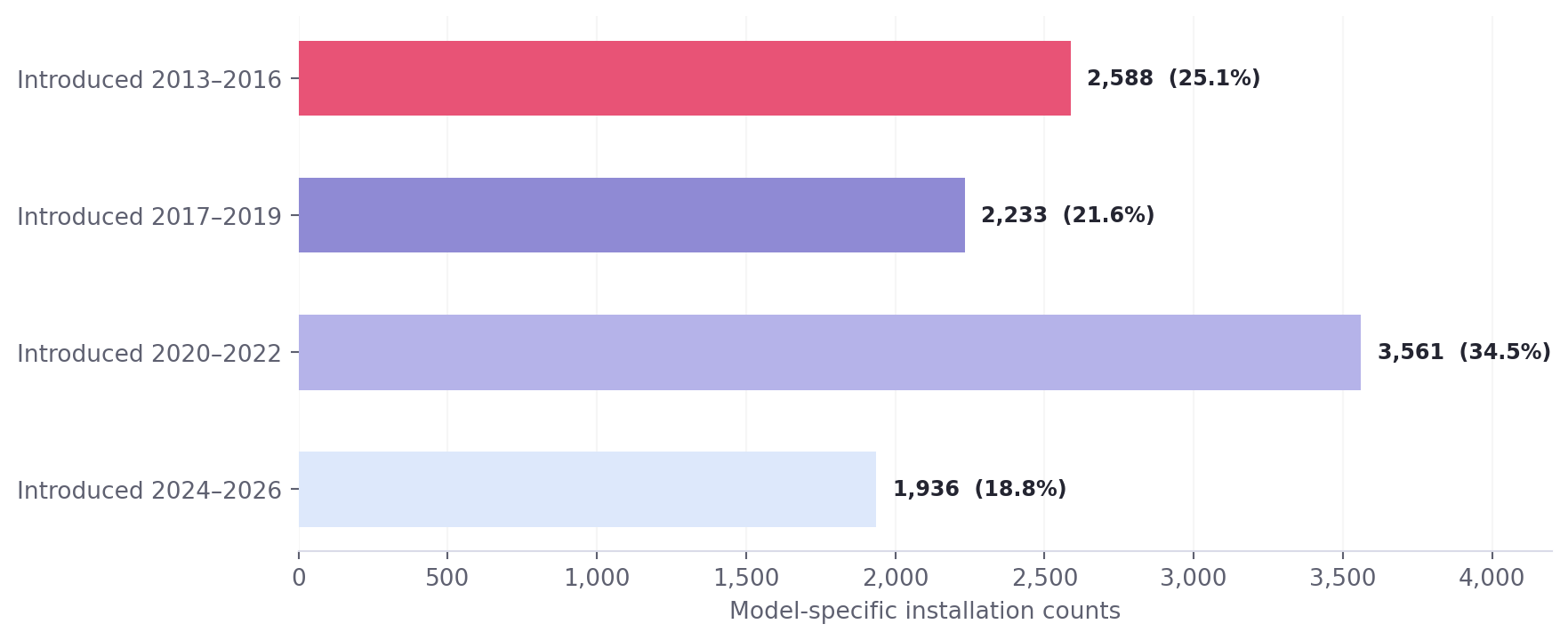
| Model family introduced | Model-specific counts | Share of model-specific counts |
|---|---|---|
| 2013–2016 | 2,588 | 25.1% |
| 2017–2019 | 2,233 | 21.6% |
| 2020–2022 | 3,561 | 34.5% |
| 2024–2026 | 1,936 | 18.8% |
| Total | 10,318 | 100% |
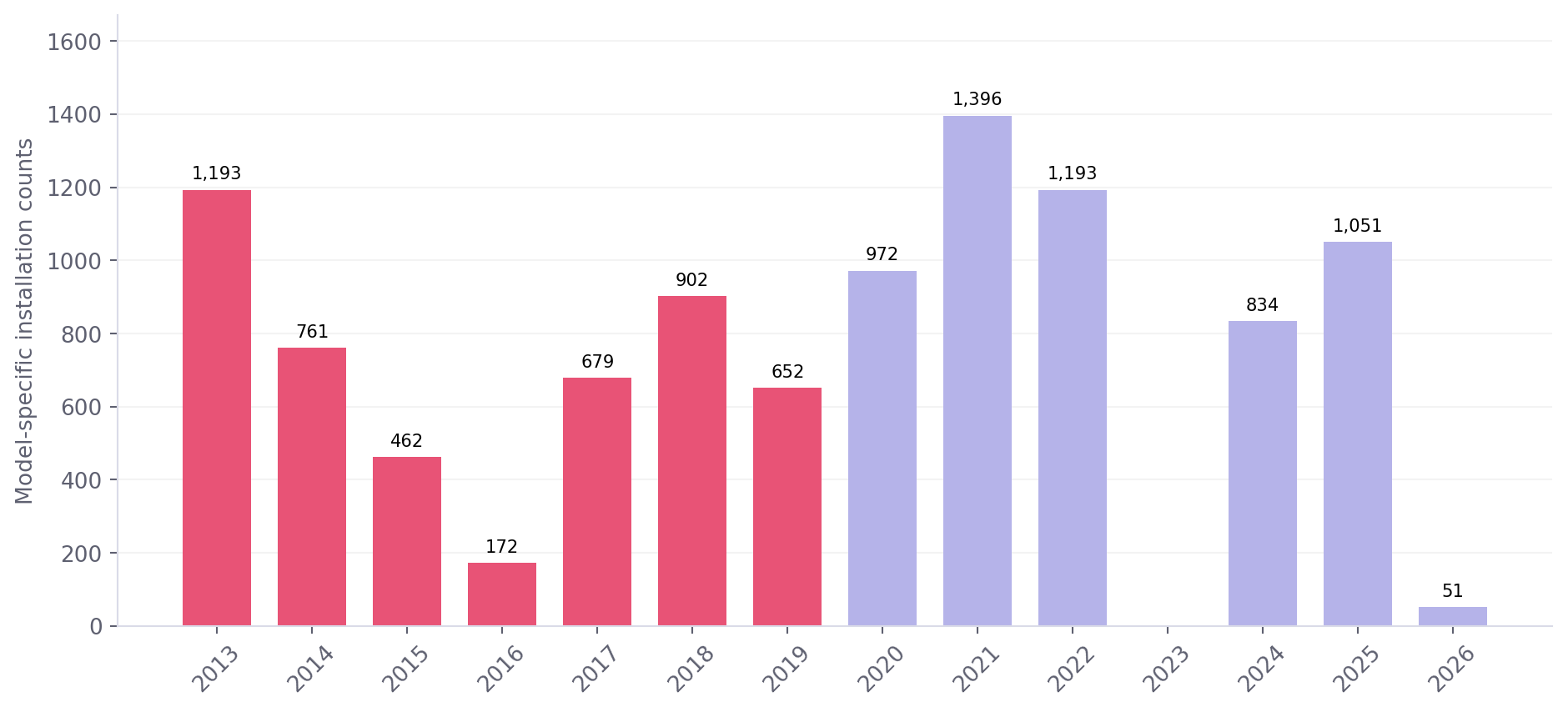
Pre-2020 model families: 4,821 / 10,318 = 46.7%. The 2013 cohort alone contributed 1,193 model-specific counts (11.6%). Model introduction year is not equivalent to the physical device's manufacture, purchase or ownership date.
3.2. Older models generated more than 36,000 slideshow starts
The app recorded 86,868 Start Slideshow events on iPad-identified hardware during the year. Model families introduced before 2020 accounted for 36,404 events (41.9%); newer families accounted for 50,464 (58.1%). That is evidence of repeated event activity within the observed app population, but is not a measure of photo display hours or completed slideshows.
3.3. Model families from 2013 remained visible in the data
The 2013 family cohort included the original iPad Air and iPad mini 2. Examples included 514 model-specific installation IDs for iPad4,1 (iPad Air) and 377 for iPad4,4 (iPad mini 2). This does not establish when the individual iPads were purchased or whether they have been continuously used since 2013.
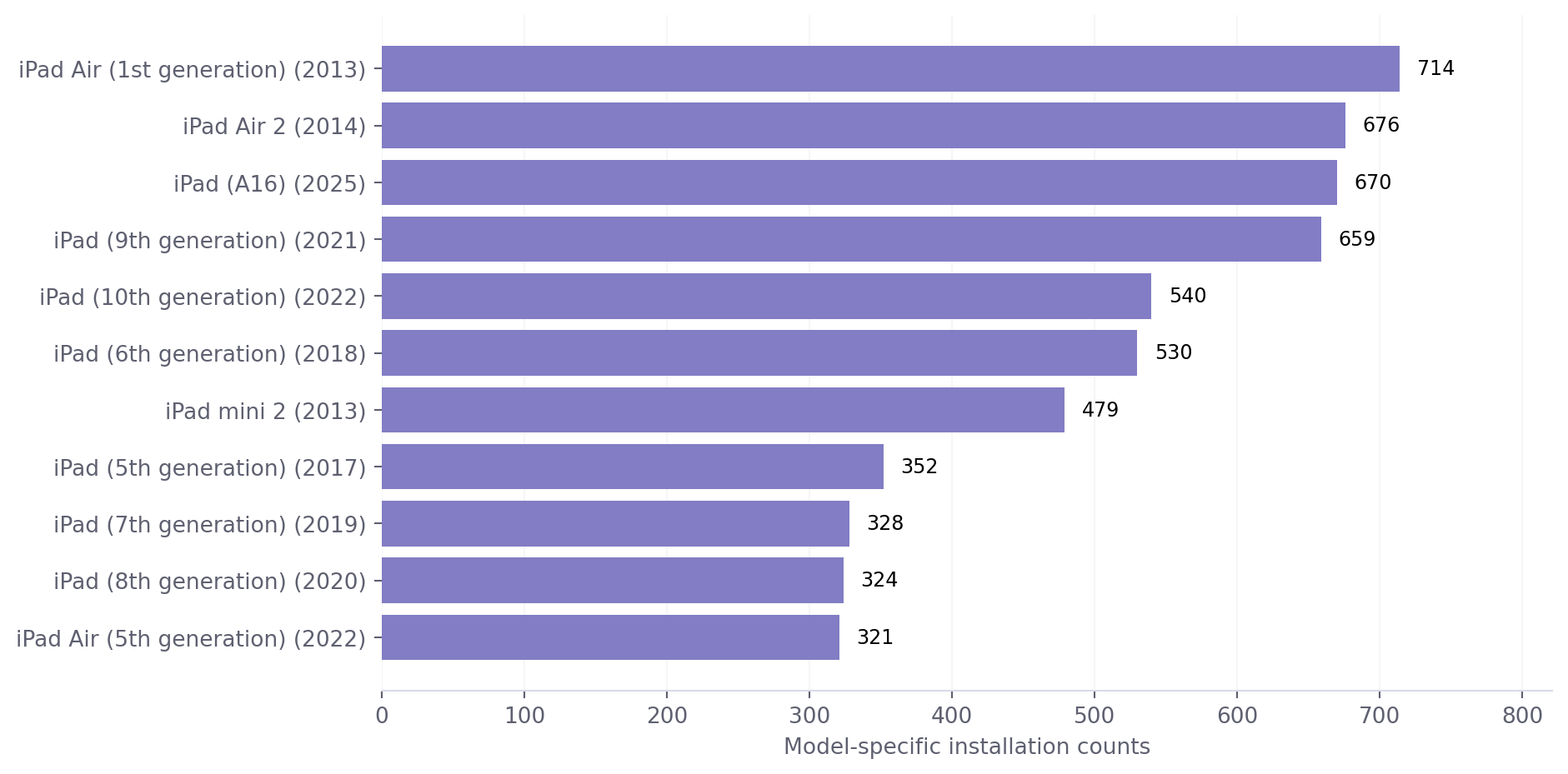
Among all families, the largest combined model buckets were iPad Air (1st generation) with 714 model-specific counts, iPad Air 2 (2014) with 676, iPad (A16, 2025) with 670, and iPad (9th generation, 2021) with 659. These are sums across cellular/Wi-Fi hardware identifier variants and are subject to the same limited overlap described in Methods.
3.4. Activity was recorded in every study month
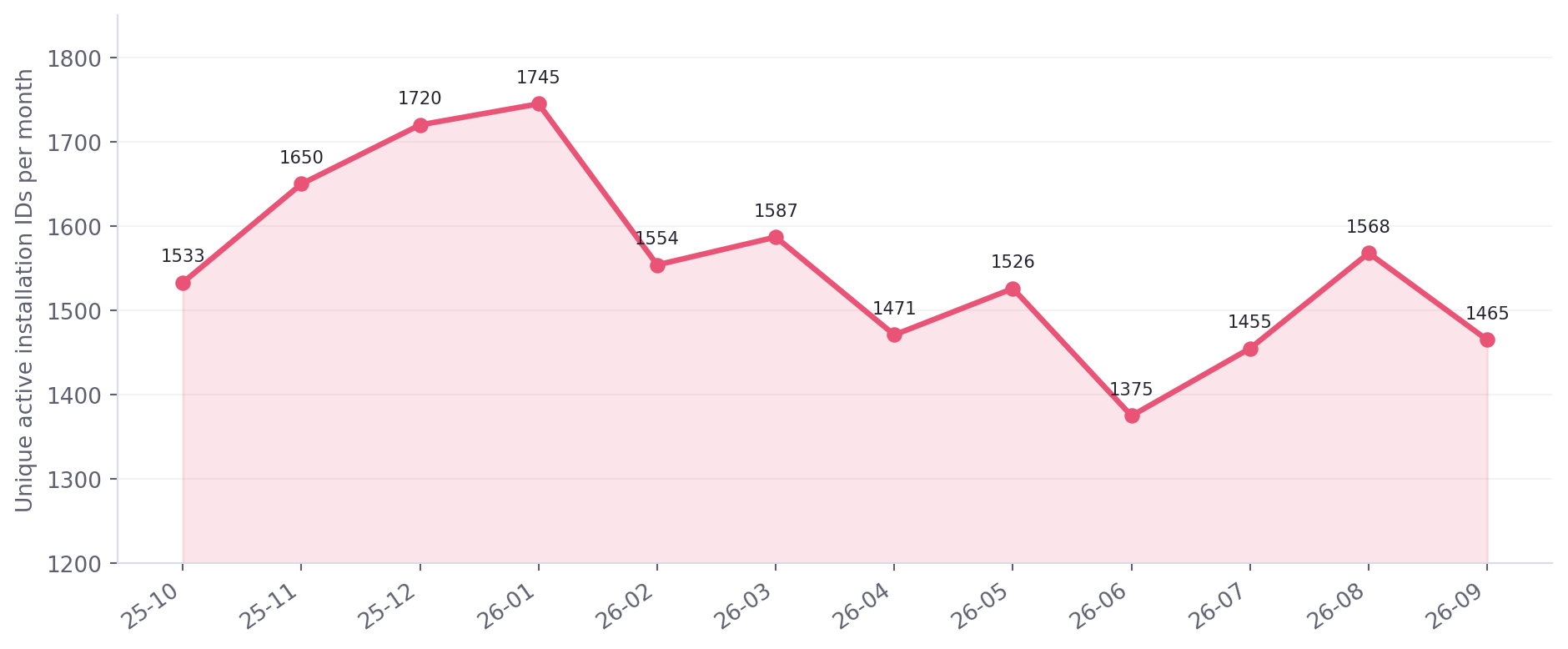
Distinct installation IDs with at least one slideshow-start event ranged from 1,375 in June 2026 to 1,745 in January 2026, with 1,465 in September 2026. Monthly values refer to distinct IDs within each month, and cannot be summed to yield distinct annual IDs.
Start Slideshow event on an iPad model.3.5. International spread
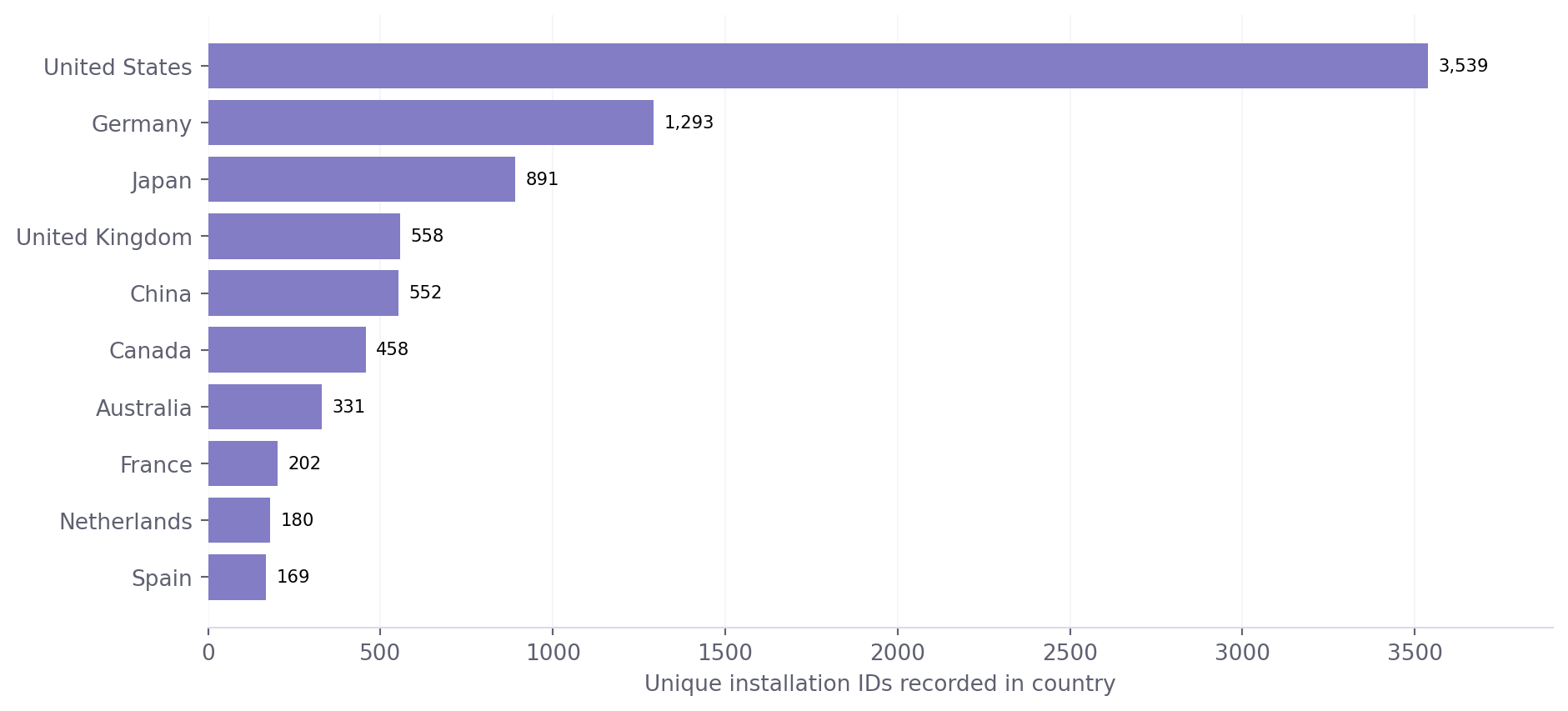
The largest counts of installation identifiers associated with slideshow starts were observed in the United States (3,539), Germany (1,293), Japan (891), United Kingdom (558), and China (552). Mixpanel country labels describe its geolocation dimension; travel, network routing and VPNs can affect assignment. These results are not representative national rates of iPad reuse.
3.6. Additional instrumentation checks
A 12-month query found 1,287 distinct iPad-model installation IDs triggering slideshow starts on an operating system with a version string beginning 12.. This independently supports the observation that the app's active telemetry includes older operating systems; it does not establish that the current App Store version can be newly installed on those devices. It may include previously installed compatible app versions. An Auto Start Slideshow event was observed for 333 distinct Mixpanel users with iPad identifiers over the year, but differences in event coverage and settings prevent treating this as a robust estimate of permanently configured photo frames.
The undefined Sources bucket contained 8,777 unique Mixpanel users, out of 10,150 users with slideshow starts; a user can appear in multiple property buckets. Source-type comparisons were therefore excluded from the publication's main findings.
4. Discussion
The findings show that an app delivering a dedicated photo-display task records meaningful numbers of event starts from model families more than seven model years old. In this population, earlier hardware generations are not simply historical installations: they were associated with 41.9% of slideshow-start interactions in the observed period.
4.1. A practical alternative to buying another display
Digital Photo Frame App offers a practical use for an iPad a household already owns: displaying an ongoing slideshow without purchasing a separate digital frame. This is a different decision from buying a new tablet to use as a frame. The potentially beneficial case occurs when someone would otherwise buy a new dedicated display, but chooses to use an existing iPad instead. In that scenario, the additional display device does not need to be produced or purchased, and the iPad may remain useful for longer before entering the e-waste stream. This is consistent with the European Union's waste-prevention hierarchy [5]. The Mixpanel observations support the technical reality of slideshow activity on older models; they do not tell us how often the substitution decision occurred.
4.2. Reuse versus a new digital frame: the environmental trade-offs
Whether reuse has a lower overall environmental footprint than a newly purchased photo frame depends on the counterfactual and the full product life cycle. A new device entails its own materials, manufacturing and transport; an existing iPad also consumes electricity and may require charging accessories, battery service or repairs. A purpose-built frame could use less electricity during continuous display, so an older iPad running around the clock is not automatically the lower-impact option. France's ecological-transition agency ADEME has found environmental benefits in many assessments of refurbished tablets compared with new ones, but those results are not a direct life-cycle comparison of iPad-as-frame versus a dedicated photo frame and must not be applied as a savings estimate here [6].
| Choice | New hardware? | Responsible conclusion |
|---|---|---|
| Use an existing iPad with Digital Photo Frame App | Not necessarily | May avoid a new purchase if it replaces one; keeps existing hardware useful. |
| Buy a new dedicated digital photo frame | Yes | Introduces an electronic product; its operating energy may differ. Net comparison not measured. |
| Buy a new iPad solely to display photos | Yes | Does not capture the reuse opportunity discussed in this report. |
4.3. What would be needed to calculate an e-waste benefit?
A future follow-up should ask a representative opt-in sample whether they previously owned the iPad, what they would otherwise have bought, whether the device was close to disposal, and how long it operates per day. Paired with measured electricity use and a life-cycle inventory for the specific alternative frame, those responses would allow an estimate of product substitution and potential net impact. Until then, the appropriate conclusion is that the app enables an observable reuse scenario, not that this study has quantified e-waste saved.
5. Limitations and publication disclosure
- Selection bias: this is the population of instrumented Digital Photo Frame App sessions, not a probability sample of all iPad owners.
- Model vintage is not physical device age: first introduction year cannot establish how long any specific device was in service.
- Identifiers are imperfect:
$device_idcan change on reset/reinstallation, and counts across models overlap by 60 model-specific IDs in this extraction. - Event semantics: slideshow starts cannot establish uninterrupted display duration, reliability or completed use.
- Not necessarily complete: possible analytics consent limitations, event loss, software release changes and unidentified internal/test traffic have not been independently audited.
- Settings data gaps: photos-source telemetry is heavily missing and auto-play events are not sufficiently validated for population claims.
- Independence: the research was conducted by the app's publisher using proprietary analytics. It has not been independently peer reviewed, and the publisher has a commercial interest in the subject.
- Environment claims: no ownership survey, displaced-purchase estimate, avoided-disposal estimate, energy measurement or causal life-cycle comparison was undertaken. Not buying an extra frame does not establish a net reduction in emissions or prevent the iPad from eventually becoming e-waste.
Author interests and AI assistance
Competing interest. The author develops and commercially distributes Digital Photo Frame App and therefore has a financial interest in the product examined. This is an author-led, first-party observational report; it has not been independently peer reviewed.
AI-use disclosure. OpenAI ChatGPT (GPT-6) assisted with queries to the author's connected Mixpanel project, aggregation checks, visualization, drafting and editorial formatting. The underlying product-analytics events are first-party app telemetry, not AI-generated observations. The named author is responsible for checking data accuracy, device-model mapping, references, privacy compliance and conclusions before depositing the report.
6. Conclusion
Among model-specific active installation counts for Digital Photo Frame App over the year ending September 2026, 46.7% corresponded to iPad model families introduced before 2020 and 25.1% to families introduced by 2016. Older families generated more than 36,000 recorded slideshow-start events. These observations demonstrate continued app activity on older iPad generations in a self-selected product population. An already-owned iPad can perform the job of a digital photo frame without requiring the purchase of a separate screen; this may avoid additional hardware demand where a planned new purchase is truly displaced. The data do not establish the average iPad lifespan, how often purchasing was avoided, or the net environmental benefit.
Data availability and reproducibility
The published companion files contain only aggregate model, year, month, country and event counts. They do not contain user IDs, device IDs, photographs, email addresses or event-level records. The original source is the publisher's Mixpanel project. Public disclosure of raw event data is not proposed because raw records can carry pseudonymous identifiers and other sensitive telemetry. Data were accessed for this report on 26 October 2026. The model-mapping procedure and aggregation denominators are described above; an external independent verification of source logs has not been performed.
References
- International Telecommunication Union and UNITAR (2024). The Global E-waste Monitor 2024. https://www.itu.int/en/ITU-D/Environment/Pages/Publications/The-Global-E-waste-Monitor-2024.aspx
- iOS Ref. Hardware strings by device. https://iosref.com/hardware-strings (accessed 26 October 2026).
- Apple Support. Identify your iPad model. https://support.apple.com/en-us/108043 (accessed 26 October 2026).
- Digital Photo Frame App (developed by Manuel Escrig). First-party Mixpanel aggregate analytics, 1 October 2025 to 30 September 2026; extracted 26 October 2026. App identity: App Store listing. Source queries remain in the publisher's private Mixpanel account.
- EUR-Lex, European Union. Waste hierarchy. Official summary (accessed 26 October 2026).
- ADEME (2022). Assessment of the environmental impact of a set of refurbished products. Publication (accessed 26 October 2026). This is not a comparison of an iPad with a digital photo frame.
Cite this research
Escrig, M. (2026). The Second Life of the iPad: A Study of Older Apple Tablets and Device Reuse in 2026 [Research report]. Zenodo. https://doi.org/10.5281/zenodo.23676153
Download the paper (PDF) · Device-model dataset (CSV) · Year aggregates (CSV). Individual event records, photos and pseudonymous identifiers are not included.